
Keep your property safe and beautiful while preserving the Island's night skies. We design and install low-glare, shielded lighting systems that meet strict local bylaws.
Dark-sky compliant landscape lighting on Martha's Vineyard uses shielded, downward-aimed fixtures with warm color temperature (2700K or less) and minimal trespass beyond property lines. Every system we install complies with the local lighting laws and regulations of the town where the property is located - so properties stay safely and beautifully lit without polluting the night sky.
Landscape Lighting
What this page covers
Shielded outdoor fixture specifications
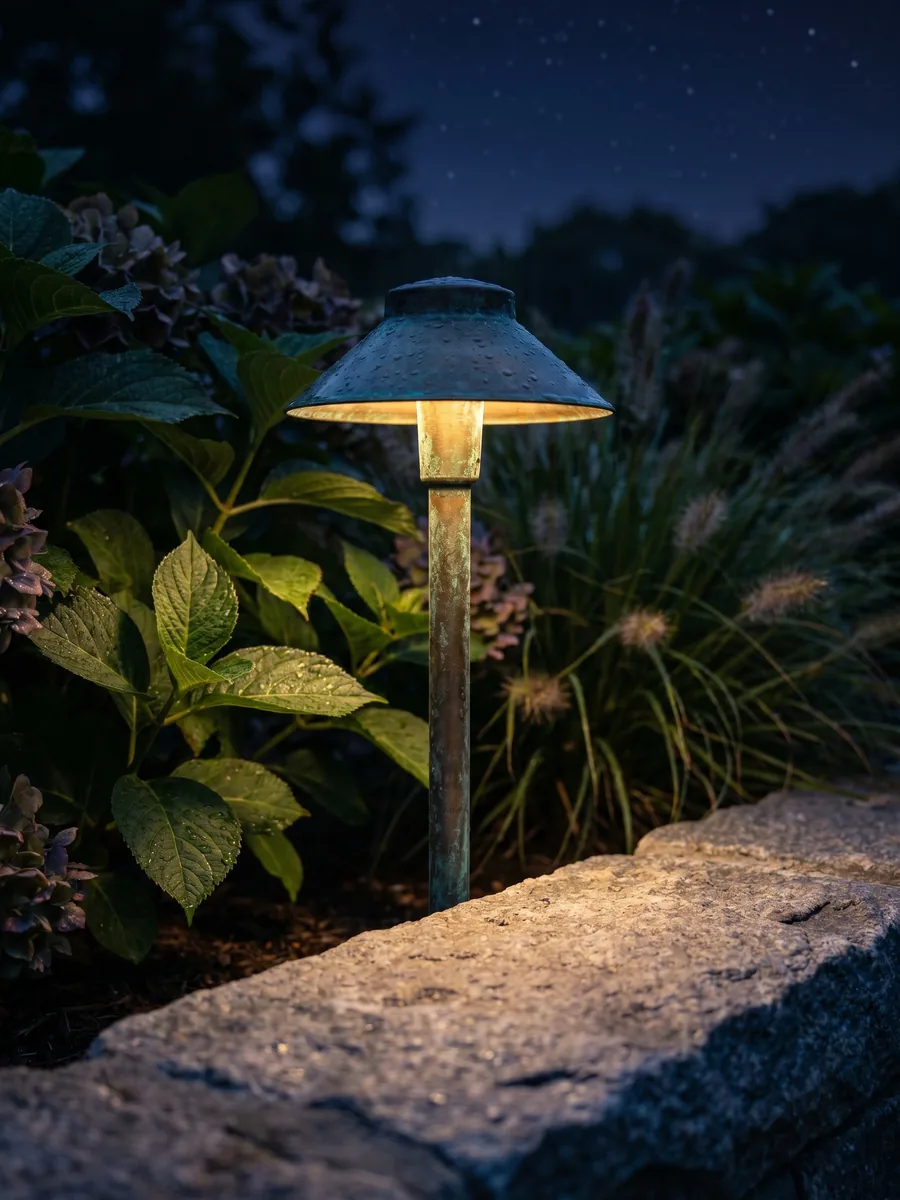
Local bylaws require that outdoor light sources are completely hidden. We install "fully shielded" fixtures that focus light downward onto pathways and ground surfaces. The bulb itself is never visible from adjacent properties or the street, eliminating glare and skyglow.
Up-island town bylaw expertise
Chilmark, West Tisbury, and Aquinnah enforce strict outdoor lighting codes. We review the height, brightness, and positioning of every fixture to ensure your system complies with local zoning rules, helping you avoid neighborhood complaints or code violations.
Warm color temperature standards
Cool-white light scatters easily in the atmosphere, creating artificial haze. We use warm-white LED light sources (2200K to 2700K) as our standard. This replicates the soft, gentle color of traditional incandescents while minimizing blue light emissions.
Precise lumen management
More light is not always better. We apply light precisely where it is needed-such as stairs and walkway borders-using low-wattage bulbs and focused beam angles. This creates safe footing while allowing the natural starlight and landscape to coexist.
Landscape Lighting
Protecting the Vineyard's night skies
Martha's Vineyard is one of the few places along the northeastern coast where the Milky Way remains visible on clear nights. Because of this, preserving dark skies is a community priority. Up-island towns have enacted bylaws to curb light pollution, regulating everything from fixture height (which must stay below the roof eave) to total property lumens.
Our design philosophy centers on restraint. We select fixtures approved by DarkSky International, aiming for low-profile path lights, downward-directed accents, and warm-toned uplighting with built-in shields. The result is a landscape that feels naturally lit, highlighting texture and path borders without shouting into the darkness.
Process
Dark sky design rules we follow
01
Light only what you need
We limit fixture placements to functional areas (steps, entries, primary paths) and high-value architectural details.
02
Direct light down
We use shielded fixtures that restrict light emission above a 90-degree angle.
03
Keep it warm
We avoid bulbs above 3000K, opting for 2200K (amber-gold) to 2700K (warm white) LEDs.
04
Use controls
We set up timers and dimmers to lower light levels during late-night hours.
Planning This Service
Frequently asked questions
Every system we design uses fully shielded fixtures aimed downward, low-lumen outputs, and warm-color LED light sources as the standard approach. We design every project to comply with the local lighting laws and regulations of the town where the property is located.
For minor path lighting and low-voltage accent lights, formal permits are rarely needed. However, large installations, new construction projects, and homes in coastal districts or conservation zones often require local review. We handle the design documentation and coordinate with town inspectors to ensure compliance.
No. By shielding the light sources and aiming them downward, we eliminate the glare that causes your eyes to adjust poorly to the dark. The contrast actually makes paths, stonework, and plantings stand out more clearly, creating a richer, more warm-toned visual depth.
Bylaws generally require consistent, warm-toned white light sources. While modern smart systems can produce color-changing effects, we do not recommend using colorful floodlights, as they violate the spirit of the dark-sky bylaws and disturb local wildlife habitats.